
Self-host Authentik
Single sign-on and a login proxy for your apps, with the admin kept private.
Shelley handles the setup. About 20 minutes.
Prefer a terminal?
curl -fsSL https://exe-staging.dev/deploy/authentik/prompt.txt | ssh exe.dev new --prompt=/dev/stdinAuthentik is an open-source identity provider. You keep users, passwords, two-factor and groups in one place, and your apps hand sign-in to it over OpenID Connect, SAML or LDAP: one account for Grafana, your wiki and your internal tools, and one place to turn someone off. For apps with no sign-in support at all, Authentik's proxy outpost stands in front of them and asks for the login itself.
This recipe runs Authentik with Docker Compose and PostgreSQL on an exe.dev VM. exe.dev supplies the HTTPS and the stable address that every token's issuer depends on, and its login lets you split Authentik in two: the login pages face the internet, while the admin interface sits on a private port behind your exe.dev account. Then you connect Grafana on another VM over OIDC, and put a login in front of an app that has none.
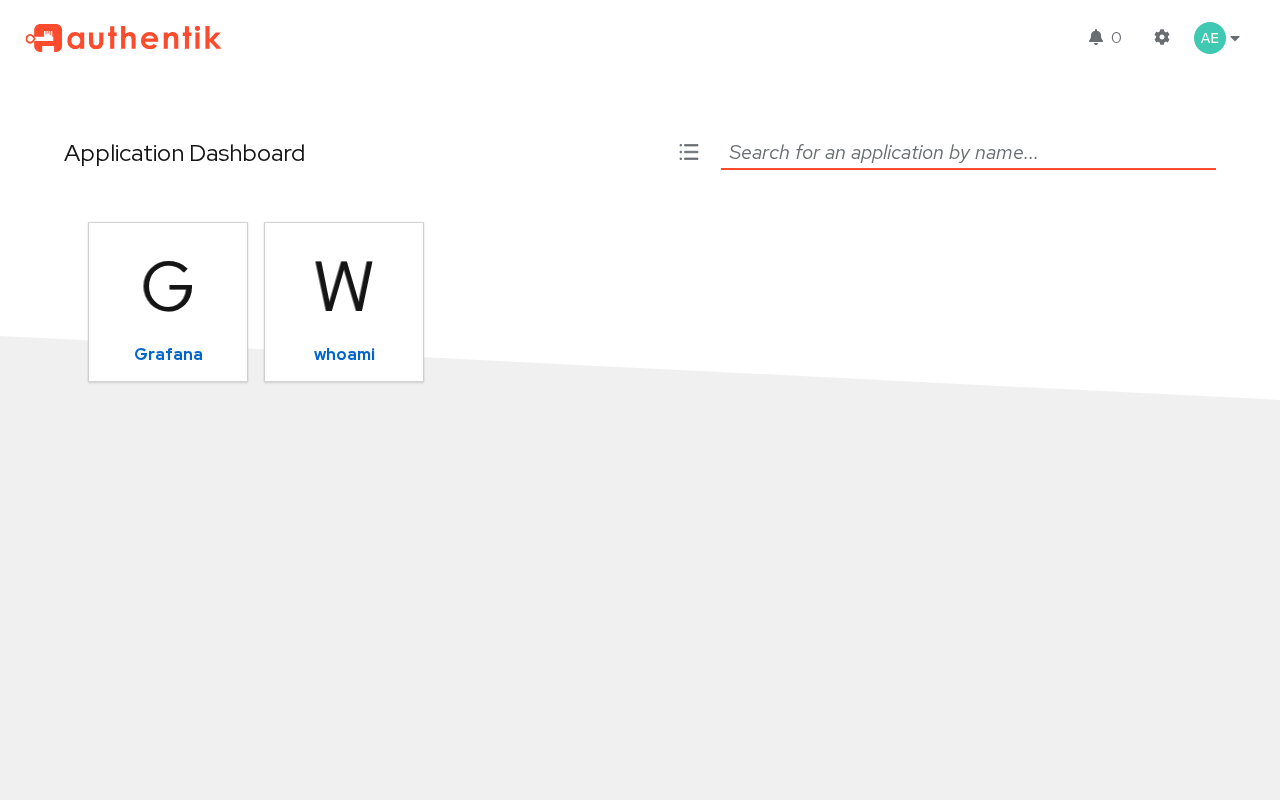
What you get#
- Authentik on PostgreSQL, with its base URL set to the VM's address and no first-visitor setup page to race for.
- An akadmin password and API token generated on the VM, in a file only you can read.
- A public port that refuses the admin interface, and a rule that stops administrators signing in there at all.
- The admin interface on a private port behind exe.dev login.
- Nightly database backups, with one restored into a scratch database to check it.
- Everything starts again after a reboot.
What's running, and where
https://my-authentik.exe.xyz/
Login pages, the users' app dashboard, OIDC, SAML and outpost endpoints, once you open it
https://my-authentik.exe.xyz:8080/
The admin interface, behind exe.dev login; the only place administrators can sign in
Deploy with Shelley#
Click Deploy and Shelley will set up Authentik on a new VM, then check that it works. No config-file wrangling required.
Prefer a terminal?
curl -fsSL \
  https://exe-staging.dev/deploy/authentik/prompt.txt \
  | ssh exe.dev new --prompt=/dev/stdin
What Shelley is told
Set up Authentik on this VM by following the exe.dev recipe at https://exe-staging.dev/deploy/authentik.md?via=deploy from top to bottom.

The recipe's example VM name is my-authentik. This VM's name is the output of `hostname`: use it wherever the recipe writes my-authentik. Skip the step that creates the VM; you are on it.

You are done when all of these are true. Check each one yourself:
- Authentik on PostgreSQL, with its base URL set to the VM's address and no first-visitor setup page to race for.
- An akadmin password and API token generated on the VM, in a file only you can read.
- A public port that refuses the admin interface, and a rule that stops administrators signing in there at all.
- The admin interface on a private port behind exe.dev login.
- Nightly database backups, with one restored into a scratch database to check it.
- Everything starts again after a reboot.

Read the whole recipe, including the closed details. For initial setup,
follow "Install by hand" first, skipping VM creation and SSH: Docker,
the settings, starting Authentik, nginx, the backup timer, and the backup
test. The walkthrough at the top is for the owner afterwards.
Work as exedev in ~/authentik. Never overwrite an existing .env. Don't
create users, groups, applications or outposts, set up SMTP or connect
apps unless the owner asks. Don't run Restore or Update. You can't make
the VM public from the VM; leave that to the owner, and don't ask them to
until you're done.
Verify docker.service and nginx are enabled, all three containers use
unless-stopped and are healthy, ./ak GET admin/version/ reports
2026.8.6, the exe.dev blueprint's status is successful, /if/admin/ on
localhost:8000 redirects to port 8080, the login flow returns 200 on
localhost:8000, the admin interface returns 200 on localhost:8080, the
backup timer is enabled and the backup test lists akadmin. Do not reboot.
Never paste a password or token into the chat; say the akadmin password
is AUTHENTIK_BOOTSTRAP_PASSWORD in ~/authentik/.env. Finish by pointing
the owner to "Open the admin interface" and "Open the login pages".

Finish with the URLs I should open.
Also at /deploy/authentik/prompt.txt. The recipe it follows is /deploy/authentik.md.
Do you need Authentik?#
Maybe not. Every exe.dev VM already has a login in front of it. A
private VM lets in only you and the people you
share it with, by email or team, and your app can read
who they are from the X-ExeDev-Email header
(Login with exe). That's single sign-on across all
your VMs, with nothing to run. If everyone who uses your apps can have an
exe.dev account, start there.
Run Authentik when:
- Your users aren't on exe.dev: customers, contractors, a club or a school, who should sign in with a username and password you manage, or with Google or GitHub.
- The app only speaks OIDC, SAML or LDAP. Many apps have a "generic OAuth" setting and nothing else. Authentik gives them a standard identity provider.
- The app has no login at all, and you want one in front of it for people without exe.dev accounts. That's the proxy outpost.
- You want groups in one place, sent to every app, so making someone a Grafana admin is an Authentik setting.
- You need policy: required two-factor, password rules, who may open which app, sign-in from LDAP or Active Directory.
How it's laid out#
Authentik answers on two ports, through nginx on the VM:
| Address | Who | What it serves |
|---|---|---|
https://my-authentik.exe.xyz/ |
Anyone, once you open it | Login pages, the users' app dashboard and settings, OIDC, SAML and outpost endpoints |
https://my-authentik.exe.xyz:8080/ |
You, after exe.dev login | All of the above plus the admin interface |
Authentik serves its admin interface from the same server as its login
pages, so the split takes two pieces. nginx sends /if/admin/ on the
public port to port 8080. And a small
blueprint adds a
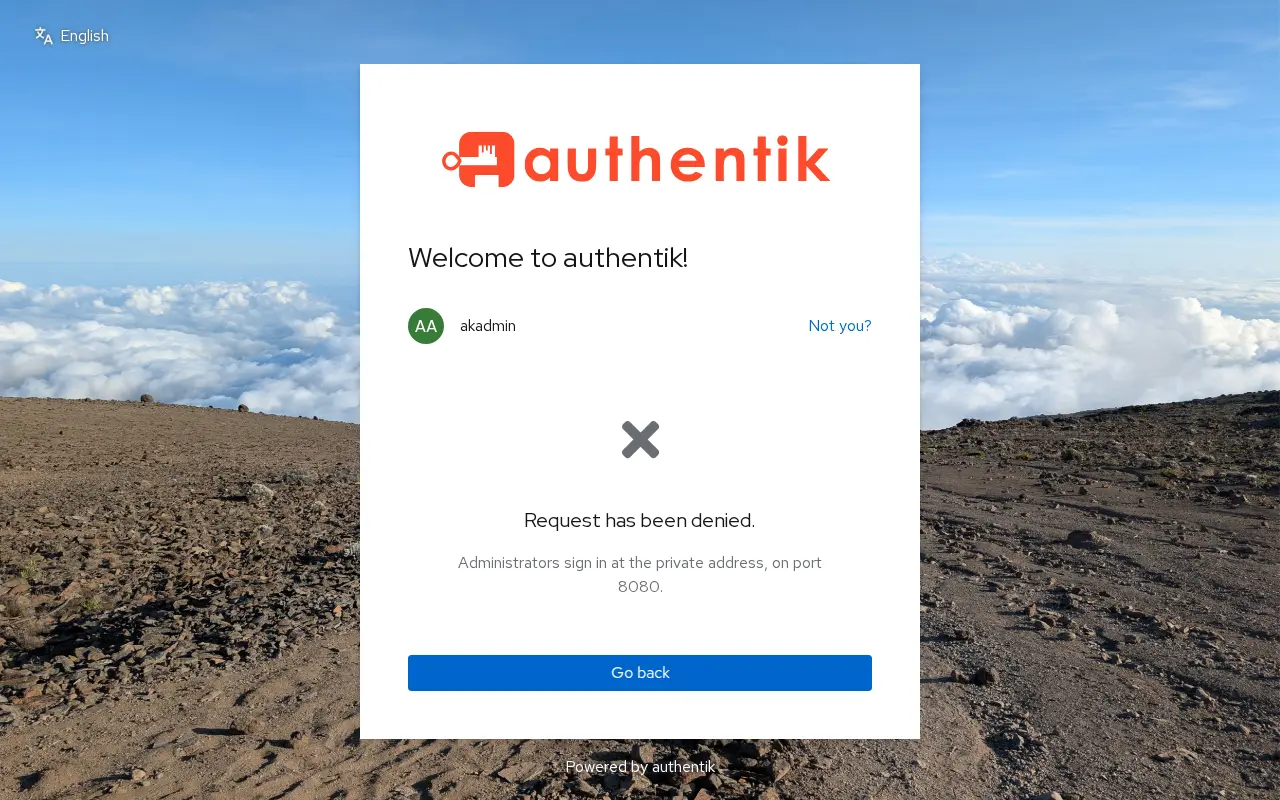
step to Authentik's login flow: when a superuser such as akadmin signs
in on the public address, the flow stops right after the username, before
any password is checked. Nobody on the internet can try an admin password.
Open the admin interface#
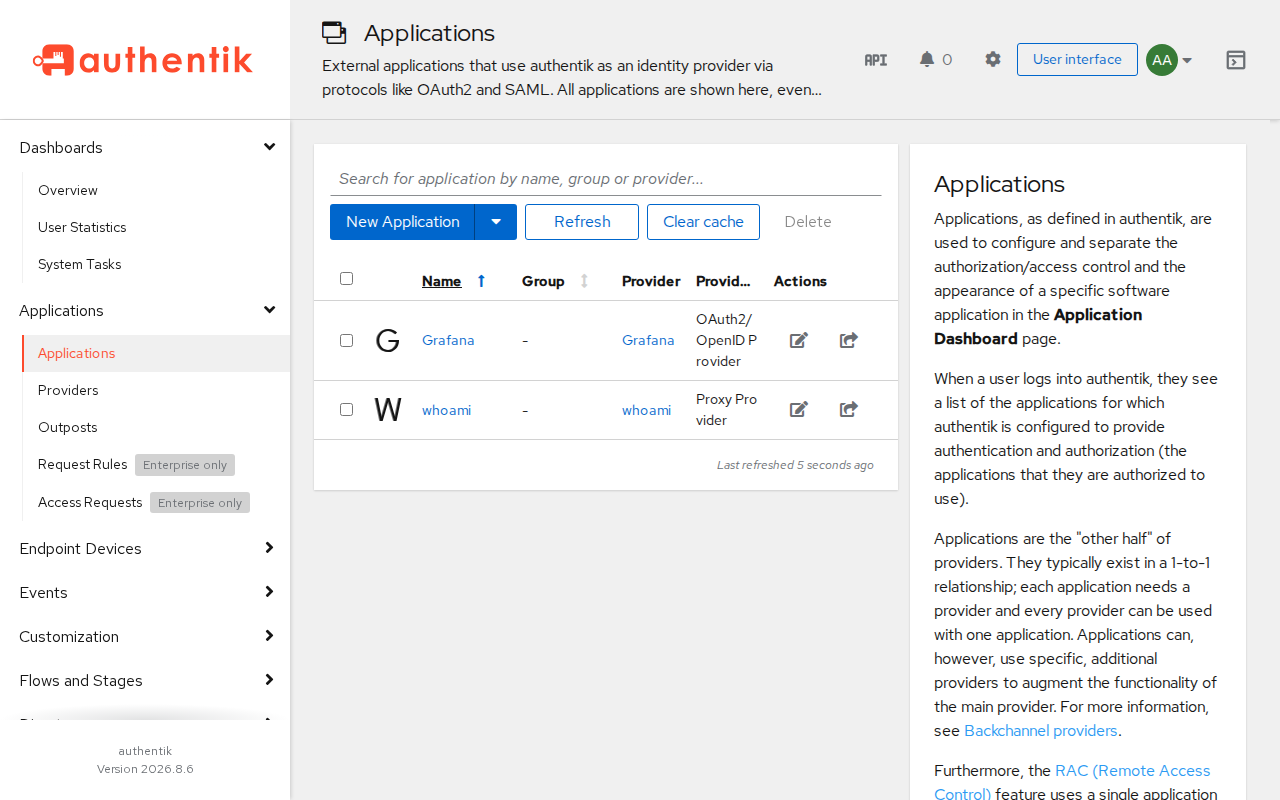
Open https://my-authentik.exe.xyz:8080/ and sign in to exe.dev if asked.
Then sign in to Authentik as akadmin. The password is
AUTHENTIK_BOOTSTRAP_PASSWORD in ~/authentik/.env on the VM. On your
computer:
ssh my-authentik.exe.xyz grep BOOTSTRAP_PASSWORD authentik/.env
That value was only read on Authentik's first start. If you change the
password in Authentik (avatar menu → Settings), the file goes stale;
update it or delete the line. Set akadmin's email there too. There's no
setup page to finish: the install set the password, an API token and the
Base URL (https://my-authentik.exe.xyz, under System →
Settings) for you, so there's no first visitor to race.
The ~/authentik/ak helper calls Authentik's
API as akadmin with the install's token, so
you (or Shelley) can script what the admin interface does. The examples
below show both.
Open the login pages#
Your users need to reach the login pages without an exe.dev account, so make port 8000 public. On your computer:
ssh exe.dev share set-public my-authentik
Port 8080 stays private: exe.dev serves ports other than 8000 only to signed-in users with access. Check from your computer:
curl -s -o /dev/null -w '%{http_code}\n' https://my-authentik.exe.xyz/-/health/ready/
curl -s -o /dev/null -w '%{http_code} %{redirect_url}\n' https://my-authentik.exe.xyz/if/admin/
curl -s -o /dev/null -w '%{http_code}\n' https://my-authentik.exe.xyz:8080/
The first prints 200; the second 302 to port 8080, sent by nginx;
the third 401, refused by exe.dev.
Add people#
In the admin interface: Directory → Users → New User, then Set password on the user's page. Groups are under Directory → Groups. Or on the VM:
cd ~/authentik
./ak POST core/groups/ '{"name":"Grafana Admins"}' >/dev/null
uid=$(./ak POST core/users/ '{"username":"alice","name":"Alice Example","email":"alice@example.com","path":"users"}' | jq -r .pk)
pw=$(openssl rand -base64 12); echo "Alice's first password: $pw"
./ak POST core/users/$uid/set_password/ "{\"password\":\"$pw\"}"
gid=$(./ak GET 'core/groups/?name=Grafana%20Admins' | jq -r '.results[0].pk')
./ak POST core/groups/$gid/add_user/ "{\"pk\":$uid}"
Send the password to them yourself; Authentik can't email anyone until
you give it SMTP. At https://my-authentik.exe.xyz/ each person
sees their apps, and under Settings can change their password, add an
authenticator app or passkey, and sign out of sessions. Once a user has
an authenticator, the default login flow asks for it.
Connect Grafana#
Here's a whole OIDC connection, end to end: a Grafana on its own VM, with no login of its own, where Authentik decides who gets in and who is an admin. The same three steps fit most apps: make an application with an OAuth2/OpenID provider in Authentik, give the app its client ID and secret, and point the app at Authentik.
Note
The Grafana recipe signs people in with their exe.dev login instead, which is simpler if they all have one. This example is a fresh Grafana VM for people who don't.
1. Register Grafana in Authentik. In the admin interface, that's
Applications → Applications → New Application with an
OAuth2/OpenID Provider, a confidential client, and the redirect URI
https://my-grafana.exe.xyz/login/generic_oauth. Or on the Authentik VM:
cd ~/authentik
app=https://my-grafana.exe.xyz
flow() { ./ak GET "flows/instances/?slug=$1" | jq -r '.results[0].pk'; }
scopes=$(./ak GET 'propertymappings/provider/scope/?page_size=100' |
  jq -c '[.results[] | select(.scope_name == "openid" or .scope_name == "email" or .scope_name == "profile") | .pk]')
cert=$(./ak GET 'crypto/certificatekeypairs/?name=authentik%20Self-signed%20Certificate' | jq -r '.results[0].pk')
prov=$(./ak POST providers/oauth2/ "$(jq -n --arg app "$app" --argjson scopes "$scopes" --arg cert "$cert" \
  --arg authz "$(flow default-provider-authorization-implicit-consent)" \
  --arg inval "$(flow default-provider-invalidation-flow)" '{
  name: "Grafana", client_type: "confidential", client_id: "grafana",
  grant_types: ["authorization_code", "refresh_token"],
  authorization_flow: $authz, invalidation_flow: $inval,
  redirect_uris: [{matching_mode: "strict", url: "\($app)/login/generic_oauth"}],
  property_mappings: $scopes, signing_key: $cert}')")
./ak POST core/applications/ "$(jq -n --argjson p "$(echo "$prov" | jq .pk)" --arg app "$app" \
  '{name: "Grafana", slug: "grafana", provider: $p, meta_launch_url: $app}')" >/dev/null
mkdir -p clients && (umask 077 && echo "$prov" | jq -r .client_secret > clients/grafana.secret)
The application's slug, grafana, is part of its issuer:
https://my-authentik.exe.xyz/application/o/grafana/. The profile
scope sends the user's groups in a groups claim, which Grafana turns
into a role below.
2. Make the Grafana VM and give it the secret. On your computer:
ssh exe.dev new --name=my-grafana
ssh my-authentik.exe.xyz cat authentik/clients/grafana.secret |
  ssh my-grafana.exe.xyz 'mkdir -p grafana && umask 077 && cat > grafana/client-secret'
ssh my-grafana.exe.xyz
3. Start Grafana, pointed at Authentik. On the Grafana VM:
sudo systemctl enable --now docker.service
cd ~/grafana && mkdir -p data
ak=https://my-authentik.exe.xyz/application/o
me=https://$(hostname).exe.xyz
test -e grafana.env || (umask 077; cat > grafana.env <<EOF
GF_SECURITY_ADMIN_PASSWORD=$(openssl rand -hex 24)
GF_AUTH_GENERIC_OAUTH_CLIENT_SECRET=$(cat client-secret)
EOF
)
cat > compose.yaml <<EOF
services:
  grafana:
    image: grafana/grafana:13.3.1
    restart: unless-stopped
    user: "1000:1000"
    ports:
      - 8000:3000
    env_file: grafana.env
    environment:
      GF_SERVER_ROOT_URL: $me/
      GF_AUTH_GENERIC_OAUTH_ENABLED: "true"
      GF_AUTH_GENERIC_OAUTH_NAME: Authentik
      GF_AUTH_GENERIC_OAUTH_CLIENT_ID: grafana
      GF_AUTH_GENERIC_OAUTH_SCOPES: openid email profile
      GF_AUTH_GENERIC_OAUTH_AUTH_URL: $ak/authorize/
      GF_AUTH_GENERIC_OAUTH_TOKEN_URL: $ak/token/
      GF_AUTH_GENERIC_OAUTH_API_URL: $ak/userinfo/
      GF_AUTH_GENERIC_OAUTH_USE_PKCE: "true"
      GF_AUTH_GENERIC_OAUTH_ALLOW_SIGN_UP: "true"
      GF_AUTH_GENERIC_OAUTH_LOGIN_ATTRIBUTE_PATH: preferred_username
      GF_AUTH_GENERIC_OAUTH_EMAIL_ATTRIBUTE_PATH: email
      GF_AUTH_GENERIC_OAUTH_NAME_ATTRIBUTE_PATH: name
      GF_AUTH_GENERIC_OAUTH_ROLE_ATTRIBUTE_PATH: "contains(groups[*], 'Grafana Admins') && 'Admin' || contains(groups[*], 'Grafana Editors') && 'Editor' || 'Viewer'"
      GF_AUTH_SIGNOUT_REDIRECT_URL: $ak/grafana/end-session/
      GF_AUTH_DISABLE_LOGIN_FORM: "true"
    volumes:
      - ./data:/var/lib/grafana
EOF
docker compose up -d --wait
Then open it to the world, on your computer:
ssh exe.dev share set-public my-grafana
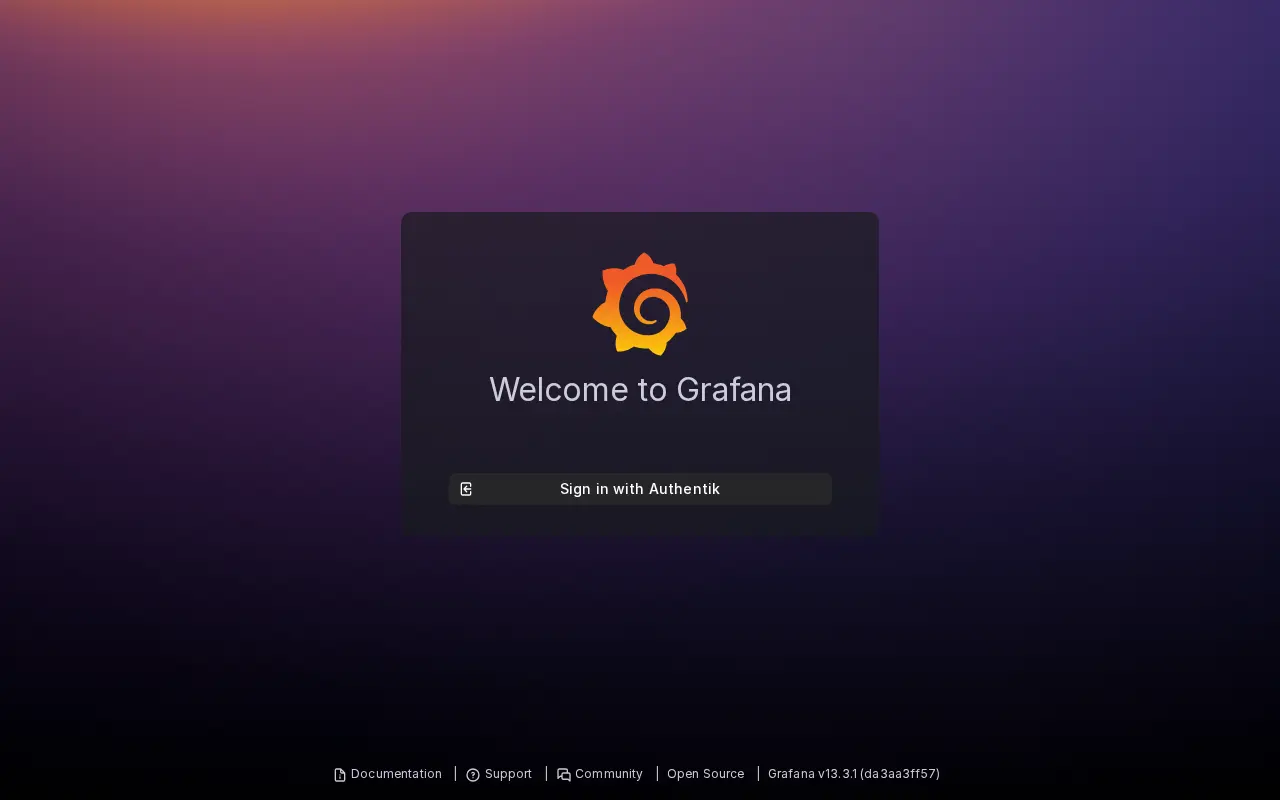
Open https://my-grafana.exe.xyz/ and click Sign in with Authentik.
Alice signs in on Authentik's page and lands in Grafana as an Admin,
because she's in Grafana Admins. Anyone else gets Viewer, or Editor
in a Grafana Editors group. Sign out in Grafana ends her Grafana
session and shows Authentik's page, where she can sign out of Authentik
too.
Grafana's built-in admin can't sign in, because the login form is off;
its password is in ~/grafana/grafana.env in case you turn the form back
on. Every user Authentik knows can open an application that has no
policy bound to it. To limit Grafana to some groups, bind them on the
application's Policy / Group / User Bindings tab, as the next example
does.
Put a login in front of any app#
Some apps have no login, or only a shared password: a dashboard, a document converter, an internal tool you wrote in an afternoon. Authentik's proxy outpost is a small container that sits in front of such an app, sends visitors to Authentik to sign in, checks they're allowed, and passes the request through with headers saying who they are.
On exe.dev, each VM has its own address, so the outpost runs on the
app's VM, next to the app, and talks to Authentik over its public address.
Here the app is traefik/whoami,
which prints the request it receives, so you can see what your own app
would get. Swap in yours.
1. Make the application, provider and outpost in Authentik. In the
admin interface: Applications → Applications → New Application with a
Proxy Provider in Proxy mode, external host
https://my-app.exe.xyz, internal host http://whoami:80; then
Applications → Outposts → New Outpost of type Proxy with that
application. Or on the Authentik VM, which also limits the app to a
team group with Alice in it:
cd ~/authentik
app=https://my-app.exe.xyz
flow() { ./ak GET "flows/instances/?slug=$1" | jq -r '.results[0].pk'; }
prov=$(./ak POST providers/proxy/ "$(jq -n --arg app "$app" \
  --arg authz "$(flow default-provider-authorization-implicit-consent)" \
  --arg inval "$(flow default-provider-invalidation-flow)" '{
  name: "whoami", mode: "proxy", external_host: $app, internal_host: "http://whoami:80",
  authorization_flow: $authz, invalidation_flow: $inval}')" | jq -r .pk)
appk=$(./ak POST core/applications/ "{\"name\":\"whoami\",\"slug\":\"whoami\",\"provider\":$prov}" | jq -r .pk)
gid=$(./ak POST core/groups/ '{"name":"team"}' | jq -r .pk)
./ak POST core/groups/$gid/add_user/ "{\"pk\":$(./ak GET 'core/users/?username=alice' | jq -r '.results[0].pk')}"
./ak POST policies/bindings/ "{\"target\":\"$appk\",\"group\":\"$gid\",\"order\":0}" >/dev/null
out=$(./ak POST outposts/instances/ "$(jq -n --argjson p "$prov" --arg h "https://$(hostname).exe.xyz" \
  '{name: "whoami", type: "proxy", providers: [$p], config: {authentik_host: $h}}')")
mkdir -p outposts && (umask 077 &&
  ./ak GET "core/tokens/$(echo "$out" | jq -r .token_identifier)/view_key/" | jq -r .key > outposts/whoami.token)
In the admin interface, open the outpost from the Outposts page and use Copy token under Outpost Deployment Info.
2. Make the app's VM and give it the token. On your computer:
ssh exe.dev new --name=my-app
ssh my-authentik.exe.xyz cat authentik/outposts/whoami.token |
  ssh my-app.exe.xyz 'mkdir -p whoami && umask 077 && { printf AUTHENTIK_TOKEN=; cat; } > whoami/outpost.env'
ssh my-app.exe.xyz
3. Start the app with the outpost in front. On the app's VM, the outpost takes port 8000 and the app has no published port, so the only way in is through the outpost:
sudo systemctl enable --now docker.service
cd ~/whoami
cat > compose.yaml <<'EOF'
services:
  whoami:
    image: traefik/whoami:v1.11
    restart: unless-stopped
  authentik-proxy:
    image: ghcr.io/goauthentik/proxy:2026.8.6
    restart: unless-stopped
    ports:
      - 8000:9000
    env_file: outpost.env
    environment:
      AUTHENTIK_HOST: https://my-authentik.exe.xyz
EOF
docker compose up -d --wait
docker compose logs authentik-proxy | grep -c 'connected to websocket'
The last line prints 1 or more once the outpost has reached Authentik.
On your computer, ssh exe.dev share set-public my-app, then open
https://my-app.exe.xyz/. You're sent to Authentik's login; Alice gets
through to the app, and someone outside team gets Permission denied.
The app sees who's there in headers like these:
X-Authentik-Username: alice
X-Authentik-Email: alice@example.com
X-Authentik-Name: Alice Example
X-Authentik-Groups: Grafana Admins|team
X-Authentik-Meta-Outpost: whoami
The outpost's version must match Authentik's, so bump its image tag when you update. It used 6 MiB of memory on our test VM.
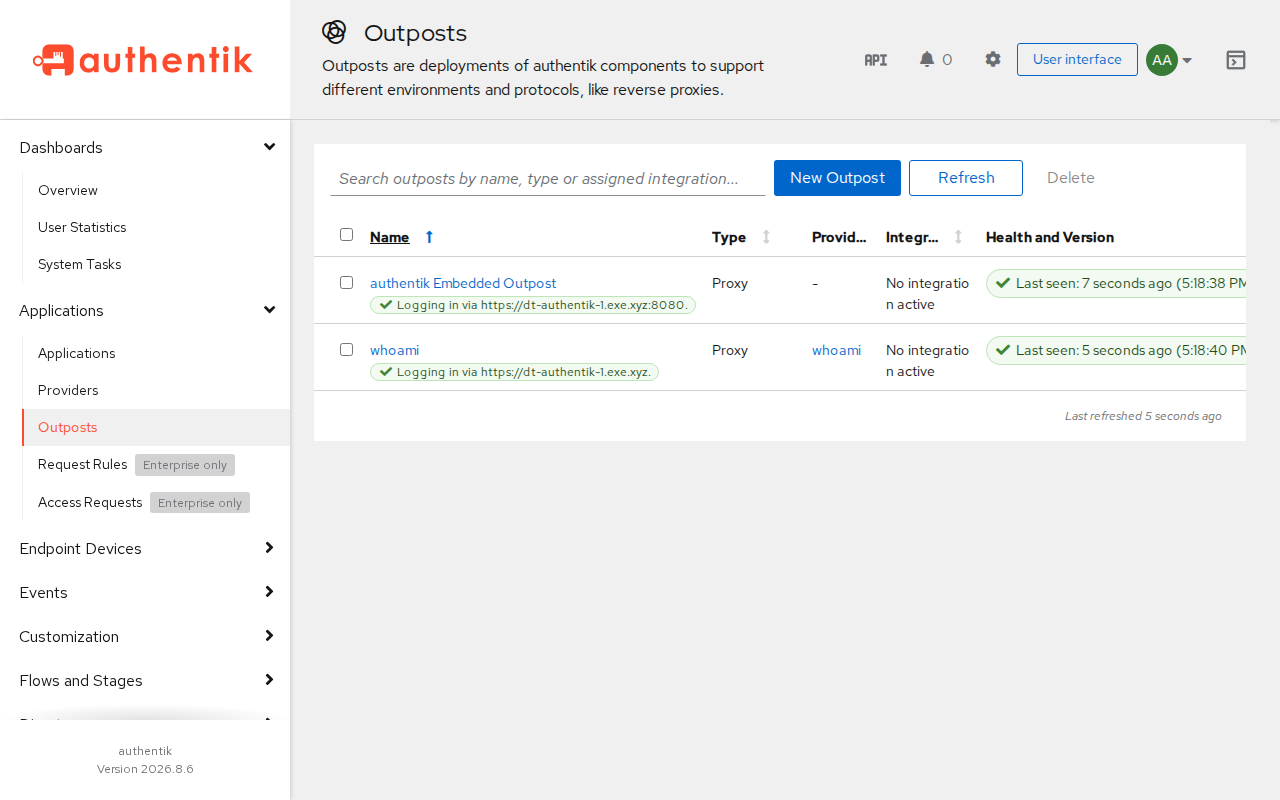
Authentik also has an embedded outpost inside its own server, which serves proxy applications whose address points at the Authentik VM. On exe.dev, each app's address leads to the app's own VM, so this recipe leaves the embedded one unused. Forward-auth mode, where the app's own nginx or Traefik asks the outpost, works too; we tested only proxy mode.
Connect other apps#
Most OIDC apps want the same few values. Make an application with an OAuth2/OpenID provider for each, as above, and give the app:
| Setting | Value |
|---|---|
| Issuer | https://my-authentik.exe.xyz/application/o/<slug>/ |
| Discovery URL | https://my-authentik.exe.xyz/application/o/<slug>/.well-known/openid-configuration |
| Authorize, token, userinfo | https://my-authentik.exe.xyz/application/o/authorize/, .../token/, .../userinfo/ |
| Client ID and secret | From the provider's page |
| Redirect URI | The app's callback, from its docs, entered exactly in the provider |
SAML providers publish metadata on their provider page, and an LDAP outpost serves directory lookups for apps that only speak LDAP; we didn't test either. Authentik's integrations site has settings for hundreds of apps.
Apps can be public, as Grafana is here, or private behind exe.dev login. A private app means two sign-ins, exe.dev's and then Authentik's, so it's usually one or the other.
Email#
Authentik sends email for password recovery, address verification and
notifications, but only through an SMTP server you configure with the
AUTHENTIK_EMAIL__* settings in .env, from any provider (see
Authentik's email docs).
exe.dev's email gateway won't do: it delivers only to
you and your team. Until you add SMTP, don't add a recovery flow, and
reset passwords yourself. We didn't test SMTP.
Sizing#
On our test VM (2 CPUs, 8 GB), after an hour of use, Authentik's server used about 570 MiB, its worker 380 MiB and PostgreSQL under 350 MiB; the whole VM used 1.1 GB. The first start takes about two minutes while Authentik sets up its database; later starts are quicker. Authentik asks for at least 2 CPUs and 2 GB of RAM. The images take 2.3 GB of disk.
Authentik or Keycloak?#
Keycloak is the other popular open-source identity provider, and has its own recipe. Both do OIDC and SAML well.
Pick Authentik for a small team that wants a friendly admin interface, a visual editor for login flows, an app dashboard for users, LDAP and RADIUS outposts, and especially the proxy outpost for apps with no SSO. Pick Keycloak when apps expect it, or for many realms, SAML-heavy setups and fine-grained admin roles; its admin console has its own address, so keeping it private takes only nginx.
The nuts and bolts#
Shelley follows these steps when it sets Authentik up for you. They're here if you'd rather do it yourself, or want to know what's on the VM.
Install by hand
Create the VM#
On your computer (pick another name if my-authentik is taken):
ssh exe.dev new --name=my-authentik
ssh my-authentik.exe.xyz
All remaining installation commands run on the VM, as exedev.
Start Docker at boot#
sudo systemctl enable --now docker.service
Write the settings#
The secrets go in .env, readable only by you. Authentik reads the
BOOTSTRAP values and the base URL only on its first start: they set
akadmin's password, create an API token for ak, and record the VM's
address, so there's no setup page waiting for the first visitor.
mkdir -p ~/authentik && cd ~/authentik
mkdir -p data certs custom-templates blueprints backups
test -e .env || (umask 077; cat > .env <<EOF
AUTHENTIK_TAG=2026.8.6
PG_PASS=$(openssl rand -hex 32)
AUTHENTIK_SECRET_KEY=$(openssl rand -hex 50)
AUTHENTIK_WEB__BASE_URL=https://$(hostname).exe.xyz
AUTHENTIK_BOOTSTRAP_PASSWORD=$(openssl rand -base64 18)
AUTHENTIK_BOOTSTRAP_TOKEN=$(openssl rand -hex 32)
EOF
)
for f in compose.yaml nginx.conf ak backup.sh; do curl -fsSLO https://exe-staging.dev/deploy/authentik/$f; done
curl -fsSL -o blueprints/admins-private.yaml https://exe-staging.dev/deploy/authentik/admins-private.yaml
chmod +x ak backup.sh
compose.yaml is
Authentik's own compose file
with three changes: the server listens on 127.0.0.1:9000 only, for
nginx; the worker doesn't get the Docker socket, which would make it root
on the VM and is only needed for outposts Authentik deploys itself; and
blueprints/ is mounted so Authentik applies
admins-private.yaml,
the rule that keeps administrators off the public address.
ak calls the API with the token.
backup.sh is for later.
Start Authentik#
docker compose up -d --wait
for i in $(seq 60); do
  s=$(./ak GET 'managed/blueprints/?search=exe.dev' | jq -r '.results[0].status')
  [ "$s" = successful ] && break; sleep 5
done
echo "$s"; ./ak GET admin/version/ | jq -r .version_current
The first start takes about two minutes, and then the worker spends
another half minute or so creating the default login flows and applying
the exe.dev blueprint; the loop waits for that. It prints successful
and 2026.8.6. Until then, the login pages answer 404.
Put nginx in front#
nginx.conf has two
servers. Port 8000 passes everything to Authentik except /if/admin/,
which it redirects to port 8080. Port 8080 passes everything. Both tell
Authentik the public host name and HTTPS, the visitor's address from the
last entry exe.dev added to X-Forwarded-For, and pass WebSockets, which
outposts use.
cd ~/authentik
sed -i "s/my-authentik.exe.xyz/$(hostname).exe.xyz/g" nginx.conf
sudo ln -sf ~/authentik/nginx.conf /etc/nginx/sites-enabled/authentik
sudo rm -f /etc/nginx/sites-enabled/default
sudo nginx -t
sudo systemctl enable nginx
sudo systemctl restart nginx
The default site goes because it also listens on port 8000. Check:
curl -s -o /dev/null -w '%{http_code}\n' localhost:8000/if/flow/default-authentication-flow/
curl -s -o /dev/null -w '%{http_code} %{redirect_url}\n' localhost:8000/if/admin/
curl -s -o /dev/null -w '%{http_code}\n' localhost:8080/if/admin/
That prints 200, 302 https://<vm>.exe.xyz:8080/if/admin/, 200.
Set up nightly backups#
sudo tee /etc/systemd/system/authentik-backup.service >/dev/null <<'EOF'
[Unit]
Description=Back up Authentik

[Service]
Type=oneshot
User=exedev
ExecStart=/home/exedev/authentik/backup.sh
EOF
sudo tee /etc/systemd/system/authentik-backup.timer >/dev/null <<'EOF'
[Unit]
Description=Back up Authentik nightly

[Timer]
OnCalendar=daily
Persistent=true

[Install]
WantedBy=timers.target
EOF
sudo systemctl daemon-reload
sudo systemctl enable --now authentik-backup.timer
Take one now and restore it into a scratch database, to check it:
cd ~/authentik
b=$(./backup.sh)
tar -xzOf "$b" ./authentik.dump > /tmp/authentik.dump
docker compose exec -T postgresql createdb -U authentik restore_test
docker compose exec -T postgresql pg_restore -U authentik -d restore_test --no-owner < /tmp/authentik.dump
docker compose exec -T postgresql psql -U authentik -d restore_test -Atc 'select username from authentik_core_user order by username'
docker compose exec -T postgresql dropdb -U authentik restore_test
rm /tmp/authentik.dump
It lists akadmin among a few internal accounts.
Back up and restore
Every night, backup.sh
writes ~/authentik/backups/authentik-<date>.tar.gz: a pg_dump of the
database (checked to contain the user table), plus .env, compose.yaml,
nginx.conf, the scripts, blueprints/, custom-templates/ and the
data/ directory of uploaded files. Two weeks are kept. The database
holds everything Authentik knows: users, password hashes, groups,
applications, providers and their secrets, outpost tokens. .env holds
AUTHENTIK_SECRET_KEY, which Authentik needs to read what it signed and
encrypted. Treat the archives like the passwords they contain.
They're on the same disk, so copy them off now and then. On your computer:
scp "my-authentik.exe.xyz:authentik/backups/$(ssh my-authentik.exe.xyz ls -t authentik/backups | head -1)" .
Or back up the whole VM to your own S3 bucket with VM backups.
Restore#
On the VM, this replaces the database with the backup's. Anything since the backup is lost.
cd ~/authentik
b=backups/authentik-20261121-030000.tar.gz   # the one you want
tar -xzOf "$b" ./authentik.dump > /tmp/authentik.dump
docker compose stop server worker
docker compose exec -T postgresql dropdb -U authentik authentik
docker compose exec -T postgresql createdb -U authentik authentik
docker compose exec -T postgresql pg_restore -U authentik -d authentik --no-owner < /tmp/authentik.dump
docker compose up -d --wait
rm /tmp/authentik.dump
On a new VM, run Install by hand up to Write the settings, but
put the archive's .env in ~/authentik first (so the secret key and
database password match) and unpack its data.tar there; then
docker compose up -d --wait, restore as above, and continue with Put
nginx in front. If the new VM has another name, every issuer changes, so
change the Base URL under System → Settings and update every
connected app and outpost.
Update Authentik
Authentik releases a new version about every three months (2026.5, 2026.8, ...) with patch releases in between, including security fixes. Read the release notes for each version you cross, and don't skip one: go to the latest patch of each version in turn. Authentik can't be downgraded, except by restoring the backup. On the VM:
cd ~/authentik
./backup.sh
sed -i 's/^AUTHENTIK_TAG=.*/AUTHENTIK_TAG=2026.8.6/' .env   # the new version
docker compose pull
docker compose up -d --wait
./ak GET admin/version/ | jq -r .version_current
Then bump ghcr.io/goauthentik/proxy: to the same version on each
outpost's VM and run docker compose up -d there: outposts must match
the server.
Compare compose.yaml with Authentik's current
compose file when the release
notes mention it; this recipe's copy keeps the three changes described
under Write the settings. Leave postgres:16-alpine alone unless the
notes ask: a new PostgreSQL major version needs a dump and restore, not
just a new image. From 2026.11, Authentik requires the Base URL setting,
which this install already sets.
Something not working?
Start with the logs, on the VM:
cd ~/authentik && docker compose ps && docker compose logs --tail 50 server worker
429 Too Many Requestspullingpostgres. Docker Hub limits anonymous pulls per address, and VMs share addresses. Wait a few minutes and rundocker compose up -d --waitagain. Authentik's own images come from GitHub's registry.- Worker logs say a relation "does not exist" right after the first start. Harmless: the worker starts before the server has finished creating the database. It stops once both are healthy.
- akadmin can't sign in: "Administrators sign in at the private
address". That's the blueprint working. Use
https://my-authentik.exe.xyz:8080/. - "Request has been denied" on
/if/flow/initial-setup/. Also expected: the install set akadmin's password, so there's no setup to do. - An endless spinner, or links that go to http://. nginx isn't
sending the forwarded headers, or something other than nginx is talking
to Authentik. Check that
nginx.confis linked into/etc/nginx/sites-enabled/andsudo nginx -tpasses. - The nginx welcome page on port 8000. The default site is back;
sudo rm -f /etc/nginx/sites-enabled/default && sudo systemctl restart nginx. - The app says the login provider denied the request. Look for the
reason with
docker compose logs server | grep -i oauth2. Invalid grant_type means the provider has no grant types ticked (theakexample sets them); a redirect URI error means the app's callback doesn't match the provider's exactly. - An outpost shows as unhealthy, or the app's VM loops on login.
Run
docker compose logs authentik-proxyon the app's VM. The Authentik VM must be public, the token must be the outpost's, and the provider's external host must be the app's exact address. ./akanswers 403. The bootstrap token was deleted or expired. Make a new API token for akadmin under Directory → Tokens and put it inAUTHENTIK_BOOTSTRAP_TOKENin.env.- Lost the akadmin password. On the VM,
docker compose exec server ak create_recovery_key 10 akadminprints a path,/recovery/use-token/.../, good for 10 minutes. Open it onhttps://my-authentik.exe.xyz:8080and set a new password.
Frequently asked questions#
My users all have exe.dev accounts. Do I need Authentik?
Probably not. exe.dev already puts a login in front of every VM, and you choose who gets in by email or team. Apps can read the signed-in user from the X-ExeDev-Email header, as the Grafana recipe does. Authentik earns its keep when your users don't have exe.dev accounts, when an app only speaks OIDC, SAML or LDAP, or when you want groups and policies shared by many apps.
Should I use Authentik or Keycloak?
Both are mature and free. Authentik is friendlier for a small team: a visual flow editor, an app dashboard for users, and the proxy outpost, which puts a login in front of apps with no SSO of their own. Keycloak is the standard for OIDC and SAML at scale, with many realms and fine-grained admin roles, and some apps expect it. See Authentik or Keycloak?.
Is the admin interface on the internet?
Not in this recipe. nginx sends /if/admin/ on the public port to port 8080, which only you reach through exe.dev login, and a blueprint stops administrators' sign-ins on the public address right after the username, before a password is checked. The API stays on the public port, because the login pages and outposts use it; it answers only to a session or token with the right permissions.
How much memory does Authentik need?
On our test VM, the server used about 570 MiB, the worker 380 MiB and PostgreSQL under 350 MiB after an hour of use. Authentik asks for at least 2 CPUs and 2 GB of RAM. A proxy outpost on an app's VM used 6 MiB.
Can I use my own domain?
Yes, with a custom domain pointed at the VM, then the host names in nginx.conf, the :8080 check in blueprints/admins-private.yaml, and System → Settings → Base URL changed to match. Do it before you connect apps: each provider's issuer contains the address. We didn't test this.
Can Authentik send password reset emails?
Only with an SMTP server you configure. exe.dev's email gateway delivers only to you and your team, so it can't mail your users. Without SMTP, set passwords yourself; people change them on their settings page.
How much does it cost?
Authentik's open-source edition is free (MIT), with no user limit. Some features, such as access requests and scheduled offboarding, need a paid Enterprise license. You pay for your exe.dev plan.
Published Nov 21, 2026 · Updated Nov 21, 2026 · tested end to end Nov 21, 2026 · Markdown · manifest.json · Something wrong? Tell us


